
The Meter
It runs on electricity, not vibes. Part three of tree.

Okay, quick question, don’t overthink it: why does anything grow at all? Not a company, not a city — everything. The whole pile. The reason you live better right now than a king did three hundred years ago, and the king had actual castles.
The answer isn’t gold, or luck, or hustle. It’s ideas. A guy named Paul Romer won a Nobel for nailing this down, and here’s the trick that makes it work: an idea doesn’t run out when you use it. Bread feeds one table. The idea of an oven feeds every table there’s ever going to be. That’s growth. Ideas stacking up, never wearing thin, long after the bread’s gone.
So AI shows up — a machine built to spit out exactly the kind of thing ideas are made of — and you’d think: great, buckle up, growth like the world’s never seen. Maybe! Hold that loosely, because there’s a catch, and it’s an ugly one.
Some economists — Bloom and his crew — actually sat down and measured it: are ideas getting easier to find, or harder? Harder. A lot harder. Just keeping Moore’s Law limping along on schedule — those chip doublings we all treat like gravity — now takes something like eighteen times the researchers it took back in the early seventies. Same law. Eighteen times the brainpower to feed it. We’re on an escalator running backwards, and it keeps speeding up. All the easy ideas got picked over generations ago. Growth’s been quietly stalling for decades, and we’ve papered over it by throwing more people at the wall.
You might be thinking: sure, but isn’t that exactly what we built AI for — to do the finding for us? Nice thought. Hang onto it. We’re about to complicate it.
Now you see why the prophets are foaming at the mouth, and — fine — I half get it. If the scarce thing was researcher-hours, and AI just made minds cheap, maybe the escalator stops running backwards. Maybe it flips. Ideas making ideas, the whole curve going vertical, no name yet for the shape it makes.
Except — and here’s where I ruin it — some Victorian called this a hundred and sixty years before anyone had opinions about GPUs. Guy named William Stanley Jevons. 1865, watching steam engines get more fuel-efficient, and he notices something nobody wants to hear: Britain didn’t burn less coal. It burned more. A lot more. Because making a thing cheaper to use doesn’t mean people use less of it — it means they use it until they’ve eaten the whole discount, then go looking for the next one. Nobody puts that part on the slide. Make an idea a thousand times cheaper to produce and you don’t buy a thousand times fewer researcher-hours. You buy a truckload more, because now you can, and the escalator doesn’t stop — it just gets more feet on it, moving faster. Cheap thinking doesn’t cool the engine down. It stokes it. Which means “AI just barely cancels the slowdown, we walk the same escalator now in robot legs” — that boring middle option from a minute ago — was already the good outcome. If Jevons is right, the bill shows up sooner. Not later.
And the bill’s gotta get paid somewhere real. Every idea, to become an actual thing, needs a body: compute — silicon, rare earths, fabs that take a decade to build. Electricity — turbines, dams, a grid that was wheezing before any of this started. Atoms, dug out of the ground by machines that run on diesel, not vibes. Thinking is cheap. Running the thought is not — and there’s a name for why some costs never fall no matter how cheap everything around them gets. Some economist called William Baumol noticed that a string quartet takes four people forty minutes today, same as it did two centuries ago. Can’t speed that up. That’s the whole point of a quartet. Same with pouring concrete for a reactor, or stringing power line across three states — none of it gets faster because the model drafting the paperwork got smarter. The atom-touching parts of the economy just sit there, watching everything around them go on sale, getting relatively more expensive for doing absolutely nothing wrong.
Want to watch this happen live? Look at Three Mile Island. Yes — that Three Mile Island, the one that half-melted in 1979 and became the punchline for “nuclear disaster” for an entire generation. Not the exact reactor that failed — the one next door, mothballed in 2019 because it couldn’t turn a profit. Well. It’s back. New name — Crane Clean Energy Center, because nothing rebrands like a haunted power plant — twenty-year contract, one point six billion dollars to raise it from the dead, and every single one of its eight hundred thirty-five megawatts already spoken for. By one company. Microsoft. For its data centers.
— Abundant energy, says the guy raising several hundred billion dollars on that exact promise.
— Abundant how, says the reactor that got switched off five years ago for losing money.
— We’re turning it back on.
— For how many customers?
— One.
That guy wrote a whole essay about how near-unlimited intelligence plus abundant energy fixes the climate, gets us a colony in space, hands us the rest of physics ahead of schedule. Lovely essay. I’d believe it more from someone who wasn’t also the one selling you the abundance, by the kilowatt-hour, the second it exists. His money got a project name straight off a UFO movie poster — Stargate — half a trillion dollars, ten gigawatts of new capacity, announced with a completely straight face in January 2025. Ten gigawatts, roughly, is what New York City pulls on a hot day. Letter two ended by asking whether a company could grow to the size of a small country. Here’s your answer: yes. If the country’s made of transformers and cooling towers instead of people, and somebody else is footing the power bill.
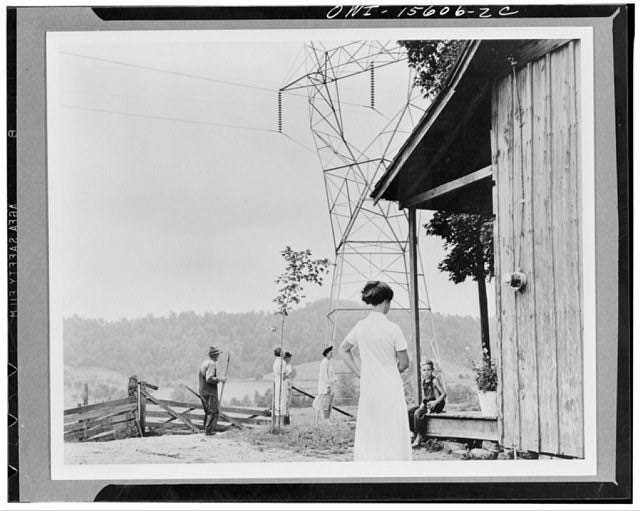
Because the power bill is not a rounding error. The people who actually track this say electricity for AI-only data centers is on pace to roughly triple by 2030, and data centers overall could eat up something like half of all new electricity demand growth in the entire country. Cognitive abundance runs face-first into a grid that was tired before any of this started, and the grid does not care how clever the thing asking for a plug is. Zoom out far enough and the economics turns back into physics, plain and simple. The scarce thing stops being intelligence. It’s atoms. Electrons. A planet with a fixed budget of them, being fought over by people who were promised the budget didn’t apply to them anymore.
I grew up inside an economy that ran the opposite experiment, and lost badly. The Soviet Union never once ran short of ideas. Had Gosplan — floor after floor of genuinely sharp people, planning everything, buried in five-year plans and directives, an absolute flood of brainpower about what should get made, by whom, by when. And the shelves were bare. Ask anyone who lived through it: the real skill wasn’t finding what you wanted. It was joining a line before you even knew what it was for. You’d see people standing, you’d stand too, and only when you were three bodies from the front would you finally lean in and ask —
— What are they giving out today?
— because whatever it was, it beat not having stood there. There was a word for the whole mess: дефицит. And it never meant the plans were missing. The plans were everywhere, in triplicate, gathering dust in triplicate. It meant the thing itself wasn’t on the shelf. Infinite planning, zero sausage. And I keep thinking the future the prophets are selling rhymes with that, just flipped shiny-side up: oceans of free thinking, free first drafts, free plans, lapping right up against the same flat wall — someone still has to make the actual thing, out of actual atoms, and the atoms don’t multiply just because you thought about them harder, or paid a smarter machine to think about them for you.

So fine. Say thinking really does go to zero. Then almost none of the value can live in the thinking, because value never sits still where things are abundant. It slides — same as both earlier letters — over to whatever’s still scarce in the next seat. Pools up at the chokepoints: the compute nobody else can build, the power nobody else can buy, the distribution nobody else owns, the trust nobody else earned. Whoever’s parked on top of a chokepoint that refused to get cheap collects rent on everybody else’s abundance. And the gap between making something good and getting paid for it — never the same move, we just spent a century pretending it was — splits wide open. You’ll be able to generate a masterpiece for free and own none of what it earns, because the money gets made at the chokepoint, and you don’t own the chokepoint. Same move, bigger board, every time. Letter one, the scarce thing was whoever answers for the work. Letter two, it was the name standing behind them. Here, it’s the wire in the ground and the turbine on the river. The payout goes to the position. Never to the work.
If you make things for a living, the takeaway’s short, and it’s not kind: get as close to a chokepoint as you can stomach. Owning the scarce thing sitting next to your abundance is the whole game — and being merely great at the abundant part just makes you the most talented person in the poorhouse, cranking out masterpieces nobody’s paying for. Wish I had a nicer line to close that one. Don’t.
Three letters, same trick every time. Scarcity never left the building — it just got up and grabbed a different chair. From the work, to whoever answers for it. From whoever answers, to the firm standing behind them. From the firm, to the atoms and the electrons and the handful of wires nobody else owns. Letter one opened with a company as a border, and the whole border was one mildly bored guy asking who you’re here to see. Strip every human worker out of the building behind Stargate or the Crane Clean Energy Center, and — guess what — you still haven’t gotten the humans out of the problem. You’ve just moved them to the gate: the guy checking badges, the loan officer who signed off on the billion dollars, the regulator stamping the interconnection paperwork, whoever’s phone rings at three in the morning when a reactor trips. Letter two ended by asking who ends up with all the rest. Here’s who: whoever’s name is on the meter. The bill always finds someone standing exactly where the scarce thing used to be, patting his pockets, wondering where everybody went.
My daughter still charges ten thousand for obsidian and a hundred thirty for feathers. I can now, with the machines, crank her out a thousand paintings of obsidian, a thousand songs about it, a whole essay like this one, all for free, all night long. Doesn’t matter. The block still costs ten thousand in her shop, because it’s still a pain in the neck to mine.
We watched a video the other night — an office tour of Mojang, the studio that actually makes Minecraft: beanbags, a slide between floors, a meeting room built to look like a cave, the whole very-Swedish production. My daughter watched it dead serious, all the way through, then asked where the game actually lives. Not the office. The game — the real place, the shop and the wall and the chest and the kid who robbed her blind.
— That’s not it, I said. That’s just where they make it. The game lives somewhere else — a big building, far away, full of computers.
— Does it look like that? she said, pointing at the beanbags.
— No. No windows. No slide. Just machines, in the dark, doing the work.
She sat with that a second, then asked if they ever turn it off.
— No. Has to stay on. Costs money to keep it on.
She nodded, satisfied, and went right back to mining, while a long way off, in a building with no windows and no beanbags, one she’ll probably never see, the meter kept spinning, and the obsidian stayed exactly as expensive as it’s always been.
P.S. The idea that ideas — non-rival, never used up — are what makes an economy grow is Paul Romer’s; that’s what the 2018 Nobel was for. The finding that ideas are getting harder to find, and that holding Moore’s Law to schedule now takes something like eighteen times the researchers it took in the early seventies, is Bloom, Jones, Van Reenen, and Webb, from a paper with almost exactly that title. The bit about efficiency making people burn more of a resource, not less, is William Stanley Jevons, watching coal consumption after the steam engine got efficient, in 1865 — economics’ oldest party trick, and it still works on data centers. The idea that some costs never fall no matter how cheap everything nearby gets is William Baumol’s cost disease, usually explained with string quartets, here explained with power plants. Three Mile Island really is being restarted, really for one customer, and the plant really has a new name — that’s Constellation Energy and Microsoft, September 2024. The essay promising abundant energy and the rest of physics is Sam Altman’s “The Intelligence Age,” and the half-trillion-dollar, ten-gigawatt joint venture with the name out of a UFO movie is Stargate — OpenAI, Oracle, and SoftBank, announced January 2025. The tripling of AI’s share of the grid by 2030, and data centers as half of new U.S. demand, is the International Energy Agency’s number, not mine. And yes — I’m still the computer-science girl who lived next door to the economics department, not inside it. I’m reporting what I read, and arranging the emphasis where the story needed it. Three letters in: thank you for reading all of them.